


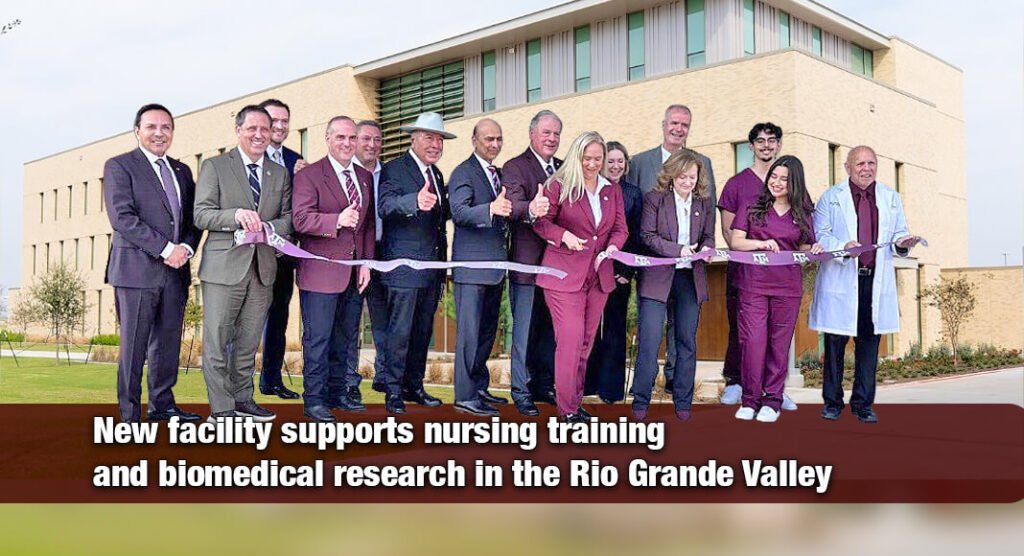
A Milestone in Nursing and Veterinary Education in the Rio Grande Valley
The recent inauguration of the Texas A&M Nursing Education and Research Building in McAllen symbolizes a significant leap in healthcare education and research in the Rio Grande Valley. This modern facility not only enhances nursing education but also fosters vital research concentrated on zoonotic diseases and public health initiatives, vital for the region.
A New Era for Texas A&M in McAllen
The Texas A&M Higher Education Center at McAllen has unveiled a state-of-the-art 61,000-square-foot facility, which combines resources from the Texas A&M College of Nursing and the College of Veterinary Medicine and Biomedical Sciences. This ambitious project was celebrated during a ribbon-cutting ceremony, attended by government officials and university leaders, marking the beginning of an era that promises to improve healthcare accessibility and education in South Texas.
The building features dedicated classrooms, collaborative study areas, and a sophisticated clinical simulation center, serving as the launchpad for the university’s Bachelor of Science in Nursing program—a program designed to prepare highly-skilled nursing professionals to address the diverse needs of the community.
Key Contributions from Leadership
Chancellor Glenn Hegar of the Texas A&M University System emphasized the long-term vision and commitment to enhancing educational opportunities in the Valley, stating, "Today celebrates years’ worth of collaborative efforts to amplify the best of Texas A&M education, research, and resources across Texas."
State Senator Juan “Chuy” Hinojosa, representing District 20, acknowledged the facility’s vital role in improving educational and healthcare resources in the region. His support has been instrumental in advocating for these enhancements, contributing to the ongoing evolution of higher education and workforce development in South Texas.
An Investment in Health Care Education
The nearly $50 million investment in this facility was approved by the Texas A&M System Board of Regents in 2023. The College of Nursing aims to produce approximately 100 new nurses annually through its four-semester curriculum in a region that is grappling with a significant nursing shortage. According to the Texas Center for Nursing Workforce Studies, the state could face a shortage of over 56,000 registered nurses by 2036, with the Rio Grande Valley alone anticipated to need nearly 6,000 additional nurses.
Preparing Future Healthcare Leaders
Leann Horsley, Dean of the College of Nursing, highlighted the importance of locally training the next generation of healthcare professionals. By doing so, the program not only meets the evolving healthcare needs of the Valley but also expands research and service opportunities tailored to the unique challenges faced by South Texas communities.
In a similar vein, Indra K. Reddy, interim chief operating officer at Texas A&M Health, expressed that the establishment will play a crucial role in cultivating nurses endowed with clinical excellence and cultural competency—skills invaluable for serving the diverse populations of Texas.
Integrating Veterinary Medicine with Public Health
The facility features a dedicated 5,000-square-foot space for the College of Veterinary Medicine and Biomedical Sciences, contributing to the One Health initiative, which aims to integrate human, animal, and environmental health. Research initiatives will focus on transboundary and zoonotic diseases—issues that pose serious threats to both animals and humans.
Bonnie Rush, Dean of the College of Veterinary Medicine, affirmed the facility’s potential to foster significant advancements in public health, specifically mentioning ongoing research efforts targeting critical diseases that can affect livestock and human health.
Operational and Community Impact
The new building will also support the Texas A&M Veterinary Emergency Team during regional deployments and participate in initiatives like Operation Border Health, which provides free medical care to Valley residents and their pets. This multifaceted approach reflects the university’s commitment to serving the broader community, aiming for tangible improvements in health and wellness.
Future Developments in Education
Since establishing a presence in McAllen in 2004 and launching academic programs in 2017, Texas A&M has seen continual growth in educational offerings, providing ten degree programs currently. Plans for future expansion include the establishment of a research facility led by Texas A&M AgriLife Research.
Ernest Aliseda, Chief Operating Officer of the Texas A&M Higher Education Center, highlighted this expansion as an investment in the local community, ensuring that students earn the prestigious Texas A&M degree while becoming part of a supportive network.
Conclusion
The opening of the Texas A&M Nursing Education and Research Building not only marks an important milestone for the university but also for the Rio Grande Valley community. By improving nursing education and strengthening local healthcare resources, this facility is set to deliver profound benefits to the region, ultimately enhancing the quality of care for all.
For more information on the programs and innovations in nursing education, check out the Texas A&M College of Nursing and Veterinary Medicine.
