


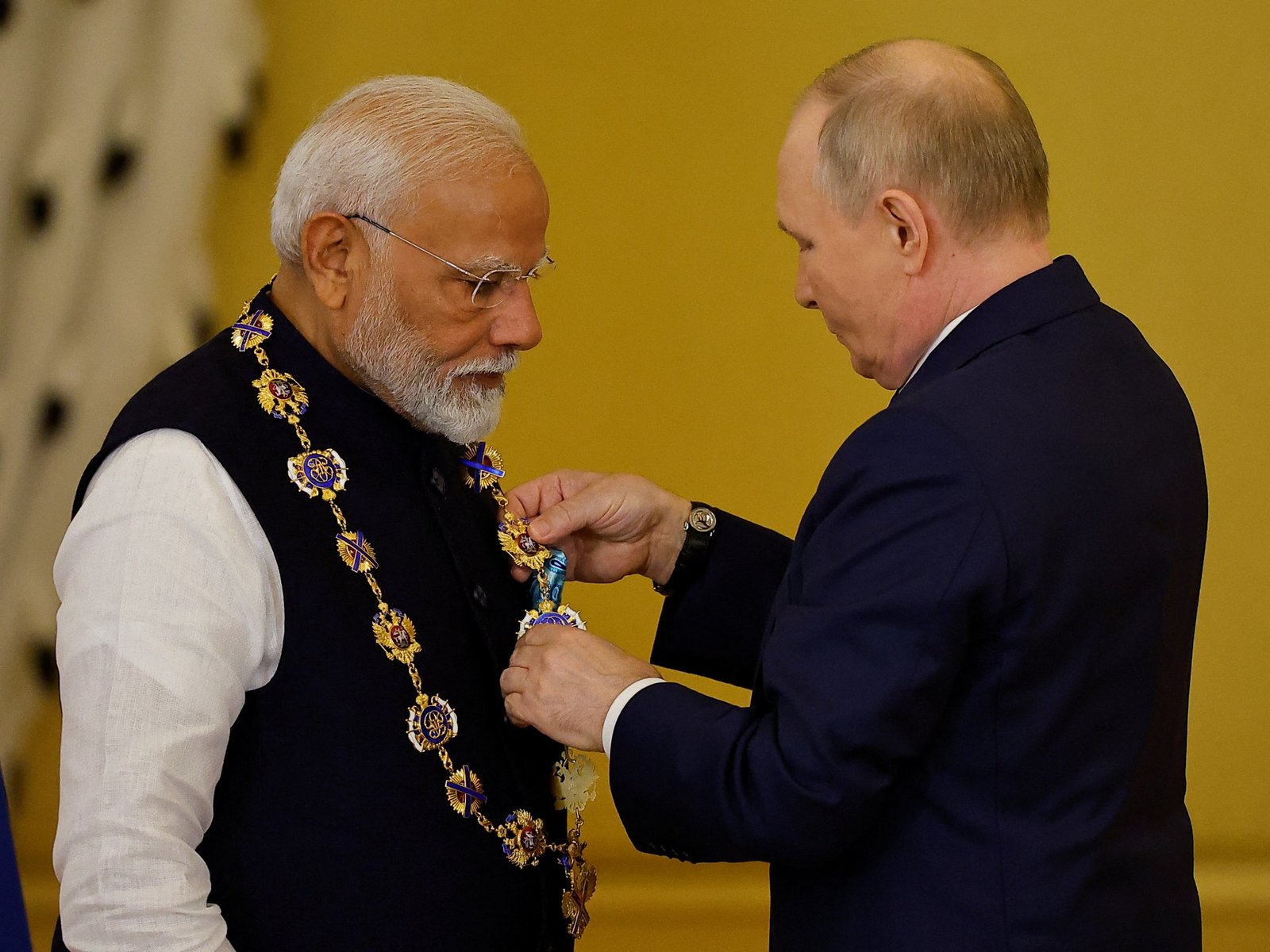
Putin’s Visit to India: A Diplomatic Tightrope in Changing Geopolitical Landscapes
New Delhi, India – In a significant diplomatic gesture, Russian President Vladimir Putin arrived in New Delhi on Thursday evening, marking his first official visit to India since the onset of the Ukraine conflict nearly four years ago. This trip comes at a time of heightened tensions between the United States and India, creating a complex backdrop for discussions centered on bilateral relations.
Personal Welcome from Modi
Indian Prime Minister Narendra Modi made headlines by personally welcoming Putin at the airport tarmac, an unusual break from protocol. Their embrace underscored the longstanding relationship between India and Russia amid external pressures and changing geopolitical dynamics.
The U.S.-India Tension
Putin’s 30-hour visit aligns with a period of increasing friction between Washington and New Delhi. The United States has imposed tariffs and hinted at sanctions against India due to its deep-rooted ties with Russia and its escalating purchase of Russian crude oil during the ongoing conflict in Ukraine. Diplomatically, this situation has forced India to maintain a delicate balancing act as it navigates its relations with both Russia and the West.
Historical Context of India-Russia Relations
Since gaining independence in 1947, India has followed a non-aligned foreign policy, steering clear from formal alliances with superpowers. Over the decades, however, it has built a relationship with the Soviet Union, transitioning into a strategic partnership with modern Russia. The backdrop of Russia’s invasion of Ukraine has raised questions about how this relationship can be sustained.
Schedule of Putin’s Visit
Putin’s agenda includes:
- Private Dinner with Modi: After his arrival, the Russian President shared an intimate dinner with Modi at the Prime Minister’s residence.
- Ceremonial Events: His Friday schedule features a guard of honor at Rashtrapati Bhavan and a visit to Raj Ghat, the memorial dedicated to Mahatma Gandhi.
- Bilateral Discussions: The two leaders will meet at Hyderabad House, a venue often used for significant political discussions, followed by meetings with business leaders.
The Kremlin has termed this visit as a crucial opportunity to enhance discussions around an extensive agenda that benefits both nations.
The Significance of Timing
This visit holds particular importance as India and Russia commemorate 25 years of strategic partnership. Despite burgeoning global pressures, both nations seek to preserve their long-standing ties. Historical annual summits, disrupted by Russia’s actions in Ukraine and geopolitical realities, are now being revived with Putin’s arrival in India after several years.
Key Agenda Items
Analysts expect that discussions will revolve around:
- Defense Deals: Putin is likely to advocate for India to purchase additional missile systems and fighter jets to bolster defense ties.
- Trade Expansion: Beyond defense, implications for sectors like pharmaceuticals, machinery, and agriculture are anticipated to be discussed.
Experts consider this summit a pivotal moment for both countries, offering avenues for reaffirming bilateral ties despite external pressures, particularly from Washington.
U.S. Pressure: An Overarching Factor
India’s crude oil imports from Russia skyrocketed post-invasion, increasing by an astounding 2,250%. However, recent sanctions by the U.S. targeting Russian oil firms have posed challenges for India’s imports. Trump’s administration has applied economic pressure on India, raising tariffs in reaction to its continued oil purchases, creating tension in New Delhi’s foreign policy approach.
Strengthening Sectors: Defense and Trade
Examining the bilateral relationship, defense remains the strongest facet of India-Russia ties. Russia continues to be a primary supplier of military equipment, comprising 36% of India’s arms imports, despite India increasing purchases from other nations to diversify its arsenal.
The nature of trade has experienced a notable shift. While bilateral trade surged to nearly $69 billion mainly due to discounted oil, India’s exports lag significantly behind, creating a trade deficit of $64 billion. Future projections indicate that both nations will need to foster additional avenues, such as labor migration, to facilitate mutual growth.
Future Trade Prospects
Trade dynamics between India and Russia are evolving. Labor migration may offer a new layer to bilateral relations, especially as Russia anticipates a worker shortage by 2030, seen as a potential opening for Indian workers to fill this gap. Yet, the overarching challenge will remain balancing relationships with major economic partners like the U.S. and the European Union while maintaining the partnership with Russia.
Conclusion: Navigating a Complex Landscape
Putin’s visit to India presents an opportunity to reinforce decades of diplomacy, yet it unfolds amidst substantial challenges. As geopolitical landscapes shift, how India manages its relationship with Russia while navigating pressure from the U.S. will shape future strategic alliances and economic growth.
For continuous updates on international relations, visit International Relations and Foreign Affairs.
This structured article aims to capture the intricacies of Putin’s visit to India, underpinning the significance of historical ties while navigating through modern-day geopolitical challenges.
