


Hong Kong Father Sentenced Under National Security Law: A New Precedent
Introduction
In a significant development under Hong Kong’s national security law, a court has sentenced a 69-year-old man to eight months in prison, setting a controversial precedent that draws attention to the increasing severity of legal repercussions faced by individuals linked to pro-democracy activists. The case has sparked outrage and concern among human rights advocates and international observers.
Details of the Case
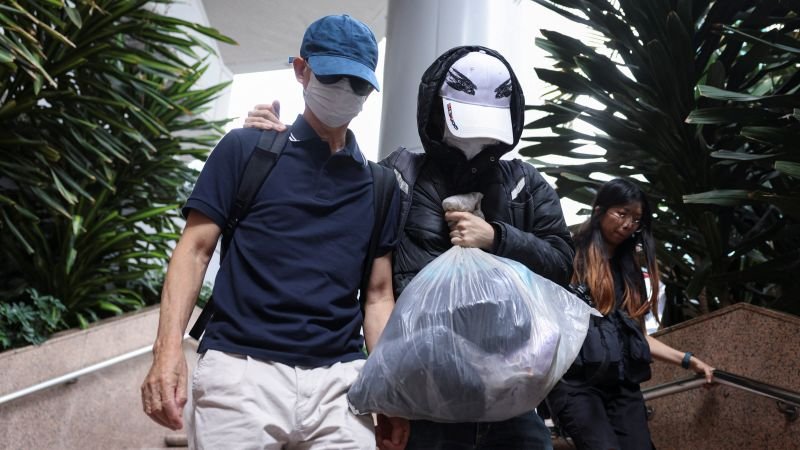
On Thursday, a Hong Kong court delivered its verdict against Kwok Yin-sang, who was found guilty of making unauthorized financial transactions pertaining to assets belonging to his daughter, an advocate for democracy. The court determined that Kwok attempted to terminate an insurance policy—totaling HK$88,609 (approximately $11,342)—originally purchased when his daughter was just two years old. This action was deemed a violation of the local homegrown national security law, often referred to as Article 23.
Background of Kwok Yin-sang
This case marks Kwok as the first person to be convicted under the specific provisions of Hong Kong’s national security law targeting asset management related to wanted individuals. Despite his pleas of not guilty, Kwok did not take the stand during his trial and appeared stoic as he was led back into custody following sentencing.
The Accusations Against Anna Kwok
Kwok Yin-sang’s daughter, Anna Kwok, has emerged as a key figure in the pro-democracy movement. As a prominent member of the Washington-based Hong Kong Democracy Council, she is among 34 activists who have been labeled as fugitives by Hong Kong national security authorities. Authorities have placed a bounty of HK$1 million (around $128,000) on her head, accusing her of colluding with foreign forces to undermine the state.
Remarks from Anna Kwok
In a reaction to her father’s sentencing, Anna labeled the actions of the Hong Kong government as "utterly despicable." She pointed out that this isn’t merely an isolated incident but a part of a broader crackdown on dissent. “This is the first case, but it is not going to be the last case,” she asserted, hinting at the chilling effect these legal actions could have on families connected to activists.
Court Commentary and Implications
During the proceedings, Magistrate Andy Cheng emphasized the seriousness of the case. He clearly stated that the law is applied without regard to family ties, asserting, “There is no such thing as collective punishment,” emphasizing that the case was strictly about the law and not familial relationships.
The Broader Context of National Security Law
This court outcome comes against the backdrop of an intensified crackdown on dissent in Hong Kong following the imposition of the national security law by China in 2020. In 2024, further amendments and expansions, dubbed Article 23, were enacted to close perceived "loopholes" in these regulations. This has raised alarm bells internationally about the erosion of civil liberties in the region.
Anna Kwok’s Reflections on Family Bonds
Amidst the legal turmoil, Anna Kwok reflected on her relationship with her father, expressing a personal wish to reconcile through affection. “Asian dads are not very known for showing affection with hugs," she noted, revealing a desire to connect emotionally in a time of crisis.
Conclusion
The case of Kwok Yin-sang illustrates the lengths to which authorities in Hong Kong are willing to go to enforce national security laws. As the repercussions of such legal frameworks continue to unfold, it raises critical questions about freedom, family, and dissent in the region. This situation serves as a poignant reminder of the challenges faced by those advocating for democracy in Hong Kong, a locality that is navigating increasingly turbulent waters in its political landscape.
For more information on Hong Kong’s national security landscape, visit Reuters or follow updates on the Hong Kong Democracy Council site.
