


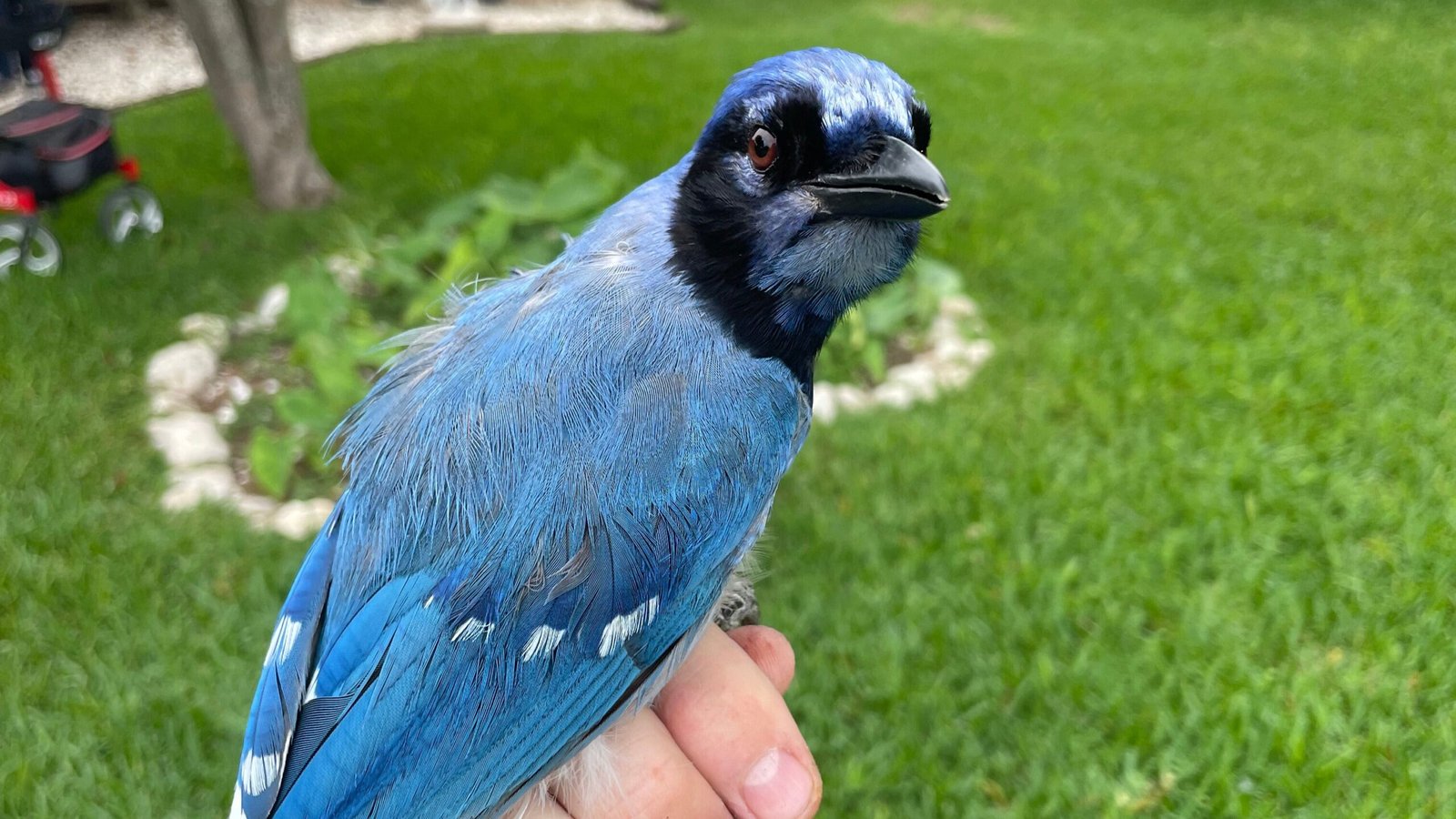
The Fascinating Hybrid: Blue Jay and Green Jay Crossbreed
In an unexpected twist of nature, a hybrid between the Blue Jay and Green Jay has been identified, marking a significant moment in avian studies. This rare occurrence not only showcases the marvels of evolution but also raises questions about the impacts of climate change on wildlife.
Discovery of the Hybrid Bird
PhD candidate Brian Stokes from the University of Texas at Austin made the landmark discovery after spotting an intriguing bird in a social media post. Initially puzzled, he quickly realized it was not a typical Blue Jay. “It wasn’t a full Blue Jay; we thought maybe it was a hybrid of sorts, which is pretty common in birds,” he explained.
Stokes was already knee-deep in research on Green Jays in Texas when this curious specimen appeared, prompting him to investigate further. After a thorough examination, which included trapping the bird and conducting blood tests, Stokes confirmed that it was indeed a hybrid—a first of its kind between these two distinct species.
The Blue Jay (left) and Green Jay (right) alongside their hybrid offspring in the middle.
A Twist from Evolutionary History
Blue Jays and Green Jays are separated by approximately seven million years of evolution, and until now, no documentation of their hybridization had been recorded. So, what caused these two species, previously continents apart, to cross paths? The answer lies in climate change.
Climate Change and Species Range Expansion
Due to rising temperatures, Green Jays have migrated northwards beyond their typical habitat in the Lower Rio Grande Valley along the Texas-Mexico border. This expansion has seen them move north by an astonishing 125 to 150 miles since the 1960s. Simultaneously, Blue Jays have also begun a westward movement, creating a scenario ripe for interbreeding.
Stokes noted, “We assumed that there would be hostility among species when their ranges overlapped; we didn’t expect a hybrid would emerge as one of the possible outcomes.” This groundbreaking finding highlights how species interrelationships are evolving in response to environmental changes.
Future Implications of Hybridization
As climate change continues to alter habitats, many species, including birds, might find themselves in new territories. Stokes explains, “Scientists predict that hybridization due to climate change is going to become more likely in the coming years.”
This specific hybrid could potentially lead to fascinating changes in physical traits. For instance, a well-adapted species like the Green Jay could, hypothetically, introduce heat-tolerant traits into the Blue Jay lineage through future hybrid pairings.
Naming the New Species
As this hybrid continues to garner attention, various names have been proposed. While some are playfully calling it the “Gru Jay”, the individual who first documented the bird has affectionately named it “Henry”.
Implications for Research and Conservation
The emergence of this hybrid has broader implications for biodiversity and conservation efforts. As species adapt to changing climates, understanding these dynamics could prove essential in ensuring the survival of diverse avian populations.
Conclusion
The Blue Jay and Green Jay hybrid not only represents a unique moment in ornithological research but also embodies the ongoing changes in our environment due to climate change. As habitats shift, scientists encourage ongoing observation and study to understand the implications for future wildlife and conserve natural ecosystems.
For more details on hybridization and climate impact on wildlife, visit National Geographic and Audubon Society.
The story of these two jays is just the beginning; as ecosystems evolve, so will the species that inhabit them.
