


Understanding the Participant Dynamics in Social Media Experiments
Key Demographics of Study Participants
In a recent social media experiment conducted by a professional online polling firm, YouGov, a diverse panel of respondents in the United States was assembled. This study focused on users of platform X, ensuring rigorous standards were met, including informed consent from all participants. Notably, participants were selected based on their self-reported usage of the platform at least several times a month.
Participant Composition
The participant demographics were strikingly uniform:
- Ethnic Background: 78% identified as White.
- Gender: 52% were male.
- Education Level: A significant 58% had completed at least four years of university education.
- Political Affiliation: 46% identified as Democrats and 21% as Republicans.
The data reveals that a substantial majority of users, approximately 66%, engage with the platform daily, while 94% access it at least once a week. Furthermore, the posting activity showed that 27% posted daily, and 53% posted at least weekly.
For a more detailed summary, view the Supplementary Information for comprehensive statistics and a comparison with data from the American National Election Studies’ Social Media Study.
Experimental Design Explained
Randomization and Control Groups
The experimental design involved randomizing participants into either an algorithmic feed or a chronological feed, with compensation provided for their participation. Detailed information about the compensation structure can also be found in the Supplementary Information.
The effectiveness of the randomization was confirmed as there were no significant demographic discrepancies between groups, apart from a slight 2% higher likelihood of algorithmic feed usage among those assigned to that group (77% vs. 75%). All analytical methods accounted for the initial feed settings, ensuring robustness in the data interpretations.
Analysis of Outcomes
Post-treatment surveys provided data regarding participant attitudes, with standardized coding of outcome variables available in the Supplementary Information. Natural language processing techniques were utilized to examine users’ feed content, categorizing posts by political orientation and by type, such as entertainment or news media posts. Specifics can be referenced in the Supplementary Information.
ITT Effects Estimates
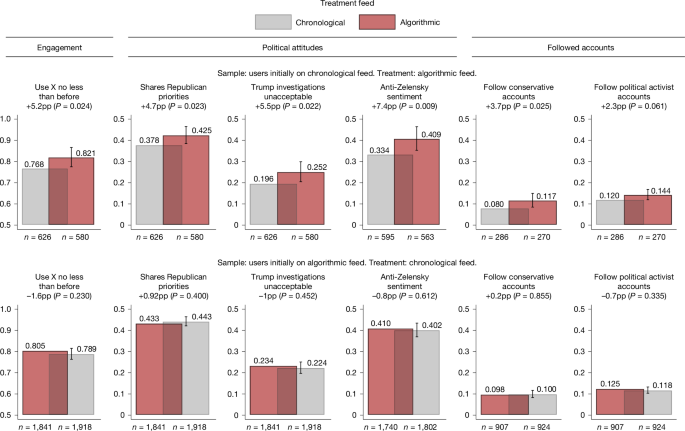
The study employed statistical models to derive Intent-to-Treat (ITT) estimates by comparing the mean outcomes for participants assigned to different feed conditions. The primary focus was on understanding how changes in feed settings influenced political attitudes.
Model Explanation
The analytical model made it clear that:
- Switching to Algorithmic Feed: This model estimated outcomes for those transitioning from a chronological feed to an algorithmic feed.
- Switching to Chronological Feed: Conversely, it looked at outcomes for users switching to a chronological feed from an algorithmic one.
These aspects are crucial in interpreting the effectiveness of feed settings on user behavior.
Visual representations of these ITT estimates are readily available, comparing unconditional estimates with those that control for pre-treatment covariates, enhancing the understanding of how differing factors affect user interactions on the platform.
Compliance and Local Average Treatment Effects (LATE)
An important aspect of the study was the low level of non-compliance among participants, which facilitated robust estimates of the LATE for those adhering to their assigned treatments. Using instrumental variables regression, the analysis classified ‘actual’ feed use during the treatment period to determine the impact of algorithmic versus chronological feeds on user behavior.
Instrument Finding and Compliance Rate
With an impressive compliance rate of 85.38%, the instruments used to assess the impacts were notably strong. The findings underscore the significance of adhering to assigned settings for deriving meaningful insights regarding user experiences on the platform.
Addressing Attrition
As with many social science experiments, attrition was observed between pre- and post-treatment surveys. However, the attrition rates were consistent across treatment groups, confirming that the results were not adversely affected. The implications of attrition were addressed using Lee bounds, further solidifying the integrity of the study’s findings.
Ethical Considerations
Ethical compliance played a vital role throughout this research. approved by the Ethics Committee of the University of St. Gallen, Switzerland, the study followed strict guidelines involving human participants. Informed consent was a prerequisite for participation, and compensation schemes were transparently communicated, with participants able to earn points convertible to cash for their involvement.
Conclusion
This extensive examination of participant dynamics in social media experiments sheds light on user behavior and attitudes influenced by feed settings. The innovative methodologies employed in analyzing data, along with the ethical rigor maintained throughout, demonstrates profound insights into the complexities of social media interactions. For a comprehensive understanding of research design elements, one can refer to the Nature Portfolio Reporting Summary.
For further exploration into the effects of algorithmic and chronological feeds or to understand their broader implications, visit related articles on social media studies and experiments.
