


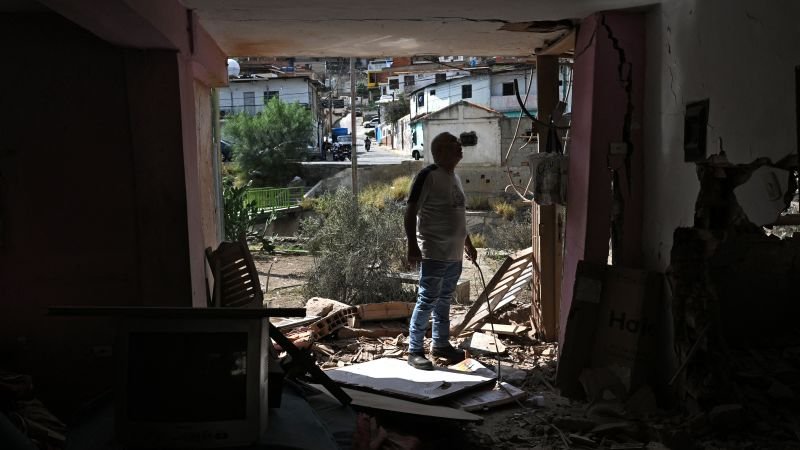
Aftermath of US Strike: Venezuelans Face Uncertainty in Caracas
Caracas, Venezuela — The day after a dramatic US military intervention that culminated in the capture of President Nicolás Maduro, citizens of Caracas navigated a new and uncertain reality. With the city shaken by bombings and a heightened state of tension, many Venezuelans took to the streets, curious about what the future holds.
The Immediate Aftermath
In the wake of the US attack that removed Maduro from power, local resident Judith Ledezma ventured outside after a night of disrupted sleep. The loud explosions from the airstrikes had jolted her awake, leading her to mistakenly believe an earthquake had struck. “I got scared and came running out with my daughter and the dog,” she shared, highlighting the chaos that enveloped the city. Her dog accompanied her on a park bench, surrounded by shopping bags filled with urgent supplies.
Ledezma’s experience reflects a broader sense of anxiety among the populace: “We have no idea what our fate will be now with this new situation. I am completely in the dark,” she lamented. This sentiment resonated with many as the streets seemed eerily quiet despite government calls to resume normal activities.
Government Response
Seeking to maintain order, Defense Minister Vladímir Padrino Lopez urged Venezuelans to go back to their daily lives, calling for a resumption of economic and educational activities. However, the call to action was met with mixed feelings. Residents like Olga Jimenez expressed skepticism about substantial changes in their lives. “Maduro or no Maduro, I don’t expect much to change in Venezuela – except maybe the lines at the shops," she remarked, emphasizing the continued struggle for basic necessities amidst uncertainty.
Concerns About Stability
As Venezuelans grapple with the chaos of this transitional phase, many worry about the implications of a sudden political shift. Mario Valdez expressed concern that an immediate change to opposition rule could incite violence. “It would mean the reds leave only for the blues to take over,” he noted, indicating the potential for civil unrest following decades of Chavismo governance.
Despite these fears, Valdez maintains a glimmer of hope for a peaceful democratic transition. He believes that the new leadership should prioritize releasing political prisoners, a gesture that could help repair the fractured trust in governance.
Voices from the Ground
Maria Azocar shared her own perspective on the situation, recalling past leaders like Marcos Pérez Jiménez and reflecting on the cyclical nature of Venezuela’s political history. “It was really an abuse on the part of the Americans,” she noted, criticizing the US intervention. Yet, she recognized the acting president, Delcy Rodríguez, as a strong figure in this new landscape. “I think with her, it eases people’s hearts a little,” she added, suggesting a tentative optimism amidst the turmoil.
The Road Ahead
With ongoing economic challenges and a tumultuous political backdrop, residents of Caracas are left to ponder the implications of Maduro’s removal. Many hope for the return of international oil companies to revitalizing an economy heavily impacted by foreign exploitation. “They stole all the money from this country to build major projects and did absolutely nothing,” Valdez remarked, stressing the need for genuine progress.
As Venezuela enters a new chapter, the path forward remains fraught with uncertainties. Citizens await not only clarity on their political future but also improvements in their daily lives — a necessity as they maneuver through the intricate landscape of post-Maduro Venezuela.
Conclusion
The dramatic capture of Nicolás Maduro has thrown Venezuela into a state of flux, characterized by uncertainty and speculation about what lies ahead. As the government calls for calm and normalcy, the voices of ordinary citizens reveal a complex tapestry of fear, hope, and the desire for a brighter future rooted in democratic values. For now, the people of Caracas must navigate a landscape that is still healing from the scars of a tumultuous political history and contentious governance.
Further Reading
For insight into Venezuela’s complex political history, visit BBC News and explore the economic ramifications of recent events at The Economist.
