


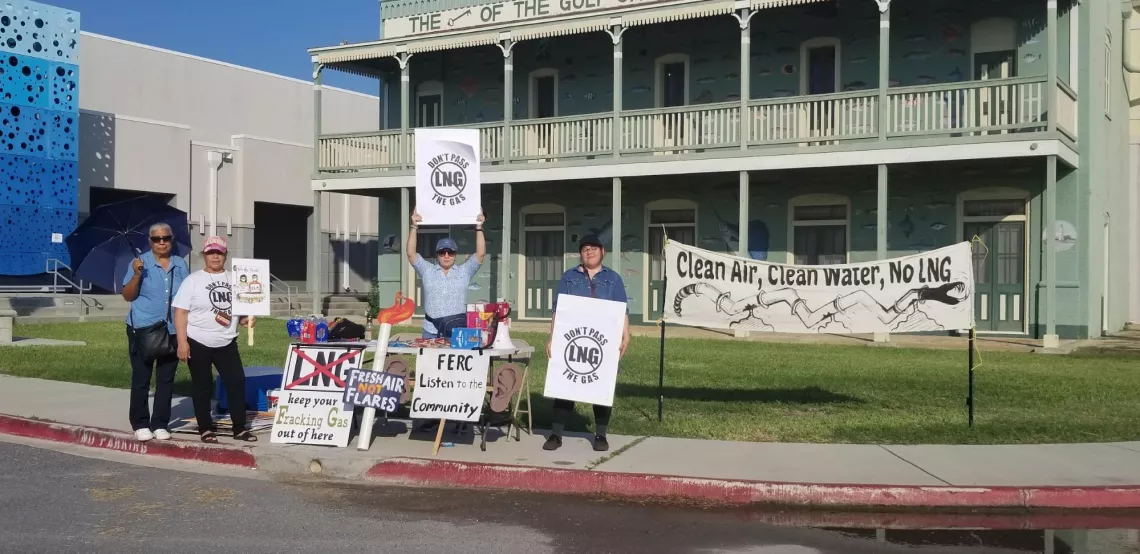
Community Stands Against Rio Grande LNG Project: A Call for Environmental Justice
Photo courtesy of Dina Nuñez
Introduction: A Growing Concern in Port Isabel, Texas
On October 3, 2023, community members from Port Isabel and surrounding areas gathered to voice their opposition to the proposed Rio Grande liquefied natural gas (LNG) project at a public meeting held by the Federal Energy Regulatory Commission (FERC). The collective stance of various organizations—including the Sierra Club, Carrizo Comecrudo Tribe of Texas, Border Workers United, South Texas Environmental Justice Network, and Texas Rising—was clear: reject Rio Grande LNG and its associated carbon capture storage (CCS) proposal.
Environmental Concerns and Community Impact
The Rio Grande LNG project, if realized, threatens to become one of the largest sources of greenhouse gas emissions and toxic pollutants in the Rio Grande Valley. Opposition has intensified due to the potential environmental hazards presented by both the LNG facilities and the proposed pipeline for CCS in Cameron County.
Last year, the community’s public pressure successfully halted Cameron County commissioners from supporting the CCS project. The technology has not been proven effective at any U.S. gas export facilities and struggles with both cost and operational issues.
Risks of LNG Facilities
Should the Rio Grande LNG project proceed, it will bring additional challenges to an already vulnerable community. The proposed gas plants would be situated on some of the last unblemished coastlines in Texas. Facilities would include towering storage tanks and flare stacks capable of generating dangerous emissions, close to residential areas and the Laguna Atascosa Wildlife Refuge.
Furthermore, the project necessitates the construction of extensive pipelines that could pose severe risks in the event of leaks or explosions. Heavy congestion from LNG tanker ships in the nearby ship channel is likely to disrupt local fisheries and threaten marine life, including endangered species like sea turtles.
Public Outcry and Call for Accountability
Criticism of the FERC’s meeting format further fueled community outrage, as residents were unable to hear one another’s comments or acquire crucial information about Rio Grande LNG’s implications. The deadline for public comments on the CCS proposal is looming, with submissions due by October 3 at 5 PM EST.
Emma Guevara, a Brownsville Sierra Club organizer, expressed her discontent with the FERC meeting, stating, “Rio Grande LNG and the CCS project will be incredibly dangerous to our community, but FERC did not seem to have our community’s best interest in mind.” The lack of transparency and public engagement has left many feeling unheard and dismissed.
Dr. Christopher Basaldú of the Carrizo Comecrudo Tribe of Texas also voiced concerns about the project impacting sacred sites, underscoring the necessity for FERC to consult with Indigenous communities in the area.
Community Voices: A Unified Stand Against Rio Grande LNG
Local activists are unified in their opposition to the project, as articulated by Lupita Sanchez from Border Workers United, who stated, "Our lives depend on clean waters so people can fish for their families… We do not need to sacrifice our health."
Additionally, Denisce Palacios from Texas Rising Action underscored that “all LNG projects are dangerous to the environment and the communities near them,” labeling the inclusion of CCS as mere greenwashing for the fossil fuel industry.
Conclusion: Paving the Way for Environmental Justice
As the community of Port Isabel and surrounding regions face an uncertain future, the voices united against the Rio Grande LNG project underscore the urgent need for environmental justice. With the community’s existing health issues and dependence on clean air and water, it is crucial that regulatory bodies prioritize community well-being over corporate interests.
Community members are urged to submit their comments to FERC, emphasizing the importance of grassroots activism in shaping a sustainable and healthy future for the region. The time for action is now.
