


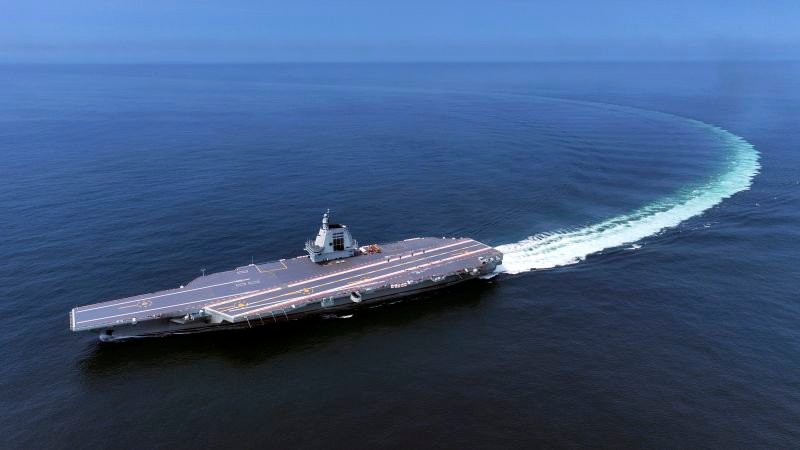
China’s Newest Aircraft Carrier: A Leap in Naval Technology and Military Power
China has recently made a monumental advancement in its naval capabilities with the commissioning of its latest aircraft carrier, the Fujian. This milestone marks a significant commitment from Beijing to enhance its military prowess and assert its influence in maritime regions, particularly as it competes with the United States for naval supremacy.
Unveiling the Fujian Aircraft Carrier
Earlier this week, Chinese President Xi Jinping officiated the commissioning ceremony for the Fujian at a military port in Sanya, located on Hainan Island. As the country’s third aircraft carrier, the Fujian boasts cutting-edge technology that differentiates it from its predecessors.
Advanced Technology: EMALS
One of the standout features of the Fujian is its implementation of Electromagnetic Aircraft Launch Systems (EMALS). This innovative technology enables the carrier to launch various aircraft types, including the J-35, J-15T, and KJ-600, with heavier payloads. The enhanced launch capability allows aircraft to carry more weapons and fuel, making them capable of striking targets at greater distances compared to older systems.
Only the USS Gerald R. Ford, part of the United States Navy, shares this advancement, having received certification for EMALS operations in 2022.
Xi Jinping’s Vision for Naval Power
Xi Jinping personally directed the integration of EMALS for the Fujian, reflecting his vision of a modernized Chinese military. During the commissioning ceremony, over 2,000 personnel witnessed Xi participate in a flag-raising ceremony and tour the vessel, emphasizing the importance of the Fujian within China’s defense strategy.
Impressive Naval Capabilities
The Fujian is not just a symbol of technological advancement; it is a tangible representation of China’s rapidly expanding navy. With the ability to displace 80,000 tons, it stands as one of the largest aircraft carriers in the world, rivaling the U.S. Navy’s Nimitz-class carriers, which weigh in at 97,000 tons.
Fleet-wide Advancements
China’s naval fleet continues to grow in scale and capability under Xi’s leadership. The launch and subsequent commissioning of the Fujian come at a time when China is constructing the world’s largest navy, actively building advanced warships to ensure it keeps pace with the U.S. and its Pacific allies.
Navigating Challenges and Limitations
While the Fujian enhances China’s maritime capabilities, it is important to note the challenges it faces. The carrier is conventionally powered, which means it requires refueling and cannot remain at sea indefinitely like nuclear-powered U.S. carriers.
Additionally, despite the implementation of EMALS technology, military experts have suggested that the Fujian’s operational capabilities may still be limited compared to its American counterparts. Some analyses indicate that its air operations could operate at only about 60% efficiency when compared to U.S. carriers.
Global Reactions and Domestic Pride
The news of the Fujian’s commissioning rapidly spread across Chinese social media platforms, becoming a trending topic with millions of views. The sentiment reflects a sense of pride in China’s commitments to modernizing its military forces.
The Future of Chinese Naval Power
As discussions regarding the Type 004, an upcoming aircraft carrier that is expected to be nuclear-powered and also utilize EMALS technology, have surfaced, it becomes clear that China’s ambitions in naval warfare are far from over. The transformation of China’s strategic naval capabilities continues, as each new vessel contributes to the country’s goal of establishing itself as a dominant maritime force.
Conclusion
The commissioning of the Fujian aircraft carrier represents a pivotal moment in China’s naval history, showcasing advances in technology and reinforcing the nation’s stance on the global stage. As Beijing continues to expand its naval capabilities, the implications for international maritime security and geopolitical dynamics will be profound.
For more information on naval technology advancements, you can explore studies on EMALS and the development of military ships in the modern era.
